
Start a Bland County Property Record Search
Bland County has no incorporated towns. Bland, Bastian, Ceres, Rocky Gap, Mechanicsburg, and the other named places are communities rather than separate property-record jurisdictions. County offices serve them all. Start from what you know. A current route address may lead to a tax-map label, while an older tract can be easier to trace from a deed description, road, creek, ridge, acreage, or adjoining owner. The county's comprehensive plan map is a handy reference for community names, though it does not define separate title offices.
These records carry different weight. The Treasurer's ticket shows what was billed or paid. The Commissioner maintains assessment information and the land books. InteractiveGIS helps orient a property search. The Circuit Court Clerk's recorded deed and plat remain the key sources for conveyance and legal description. No single step amounts to a title opinion or a boundary survey.
- Write down the road or route address and community name, then look for a matching location in Bland County InteractiveGIS.
- Carry the tax-map or parcel label to Bland Treasurer e-Services and try the Department/Bill Number or Parcel Number route.
- Ask the Commissioner of the Revenue for the assessment card or land-book entry when the online result does not show an owner field.
- Check the latest deed in Virginia SRA/COVERS or at the Circuit Court Clerk, then compare its legal description with any plat or survey.
- For older deeds or records that are not online, use the Clerk's counter and the Library of Virginia finding aid.
Offices Behind Bland County Records
Bland County divides the work among several custodians. The Circuit Court Clerk combines recorder, probate, and court duties. The Commissioner assesses land and administers tax programs. The Treasurer handles tax bills and payments. Building, Planning and Zoning keeps the permit and land-use review process. The records may all refer to one parcel, yet they are not interchangeable, so note which office supplied each fact.
Bland Circuit Court Clerk
612 Main Street, Suite 104
Bland, VA 24315-0295
(276) 688-4562
Commissioner of the Revenue
612 Main Street, Suite 100
Bland, VA 24315
(276) 688-4291
Bland County Treasurer
Real-estate ticket inquiry
Payment history and yearly taxes paid
Online e-Services
Building, Planning and Zoning
612 Main Street, Suite 204
Bland, VA 24315
(276) 688-4622
Bland County Tax Ticket Search
The Treasurer's online inquiry is the clearest public option. Reach for it when a tax ticket or parcel number is in hand. Its landing page offers separate real-estate inquiry paths plus payment history. It does not present an owner-name or situs-address search. A ticket result is not an assessment card. It answers billing questions, while the Commissioner holds the assessment record.
The visible controls are narrow but useful. A Department/Bill Number route uses the ticket identifier. A Parcel Number route uses the county parcel key. The public landing page does not state its exact punctuation or format. Separate actions show payment history and yearly real-estate taxes paid. Personal-property and utility options are separate categories, so choose the real-estate path for land.
| Department/Bill Number | Find a real-estate tax ticket when its bill identifier is known. |
|---|---|
| Parcel Number | Open the real-estate ticket by parcel; the format is not stated on the landing page. |
| Payment history | Review posted payments for the real-estate account. |
| Yearly taxes paid | Check year-by-year real-estate tax payments. |
The Bland Treasurer e-Services page shows these choices before a search begins. A ticket can help confirm that a parcel key is plausible. It does not establish a transfer or a boundary.
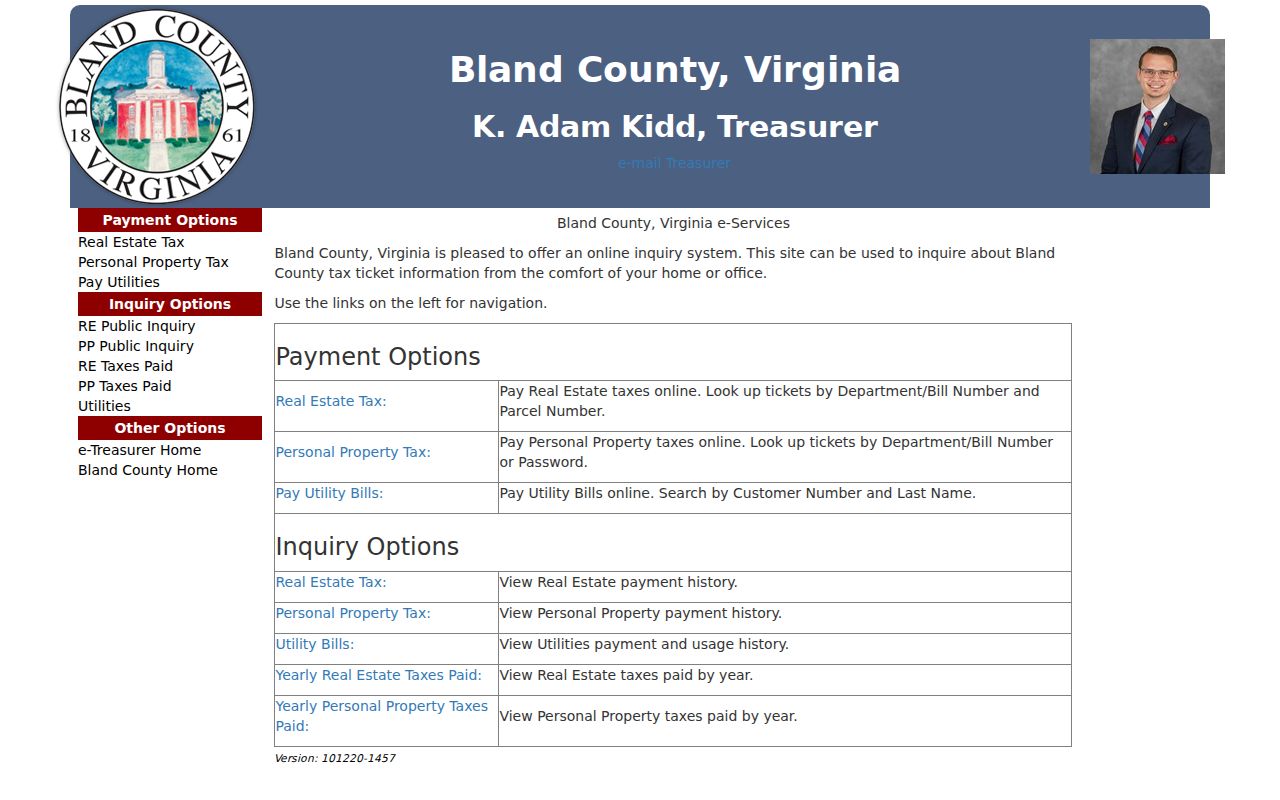
The menu is a ticket lookup, not a full parcel profile. After using the ticket to anchor the parcel, take any owner or value question to the Commissioner.
Bland County Assessment Cards
The Commissioner of the Revenue is Bland County's chief assessing officer. The official office page gives contact and form information. The county publishes no online parcel-card search. According to the reassessment FAQ, a property card may be viewed in person or obtained by fax. The land books contain information on taxable property. They may be viewed at the hearing location and the Commissioner's office.
Offline access matters here. A buyer, heir, or owner can get the charged owner, assessed value, or exemption details. Ask for the property card by parcel or location. Confirm which fields are available for the year in question. The exact owner-field label and any last-sale or exemption fields are not shown on a public online page. Rely on the office for those details.
The same FAQ says a neighbor's assessment can be viewed. That is a practical way to compare land-book entries during a valuation review. Still, one nearby assessment does not prove two parcels share the same acreage, access, improvements, or site features. Keep the assessment year and parcel description with each comparison.
Bland County Deeds in SRA
The Clerk of the Circuit Court records and indexes deeds, surveys, deeds of trust, judgments, liens, leases, and other writings affecting property. Virginia's SRA/COVERS system can provide a party index where the clerk enables access. The Available Courts list shows which clerks offer free index-only access. Image access is controlled by each clerk and may require registration, a signed agreement, subscription authority, and fees.
Bland County publishes no online index cutoff, image price, result limit, or document-type list. Start with a grantor or grantee name. Record the document type, date, index details, and book or page reference that appear. If an image is not open to the public, use the Clerk's counter or ask the office which copy route applies. The index points to a record. The instrument itself supplies the legal description and terms.
Virginia's SRA page explains the distinction between index access and subscription image access. The Bland Clerk's office also accepts e-recordings through Simplifile and CSC, but those vendor routes serve document filers, not public title certification.
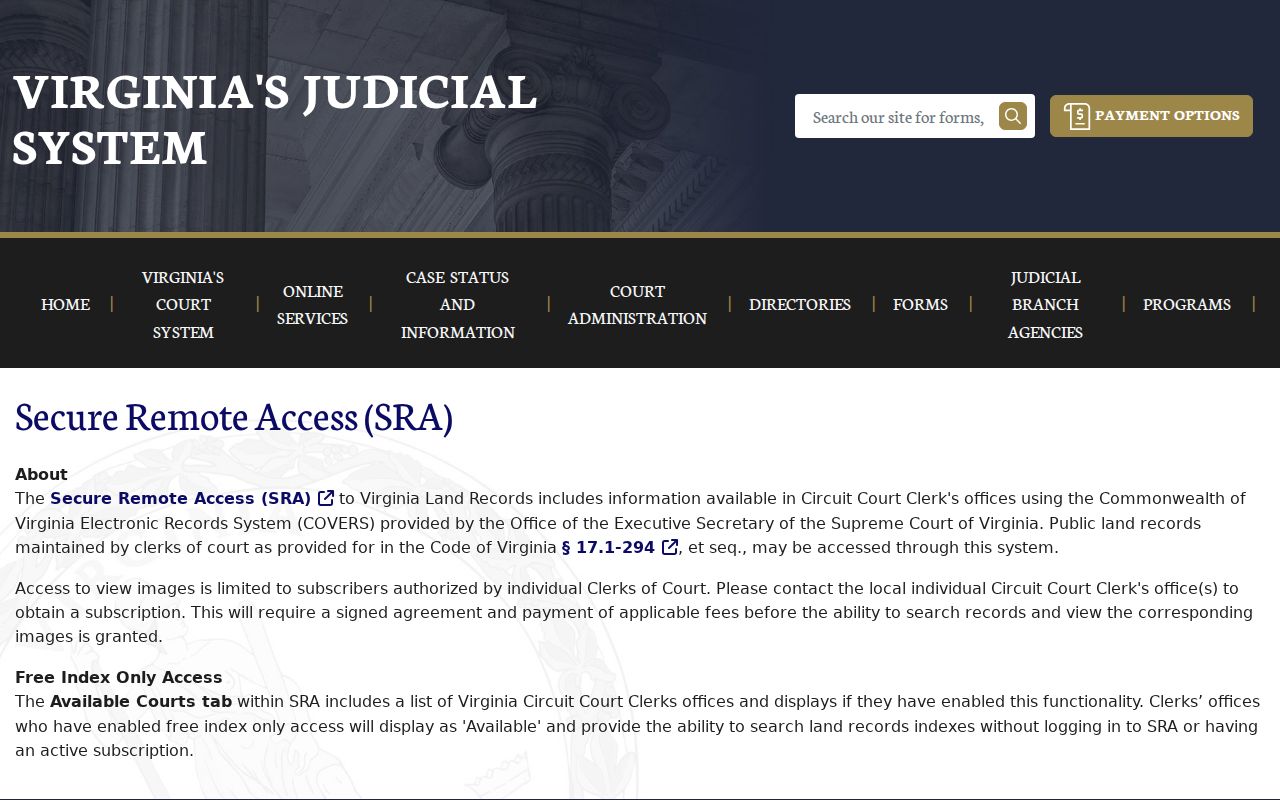
The SRA index serves one purpose for Bland County deed work. It points you to the right instrument. Once you have the book and page, the Clerk holds the recorded copy. Public viewing of the image is not guaranteed through the search itself. Ask the office for the image or a certified copy instead. The Bland Circuit Clerk's page lays out land-record duties and current filing information. Check it before a visit or a records request.
The Clerk, not the county map viewer, keeps the recorded instrument. Keep that division of labor in mind. When an assessment entry and a recent transfer disagree, the current deed is the next document to pull, along with any plat it references.
Bland County Property Record Types
Bland County spreads its property record trail across several offices, and no single screen holds it all. A deed records the conveyance itself. An assessment shows who was charged. A tax inquiry shows what was actually paid. Match the source to the fact you are checking rather than treating one office's entry as a complete property file for Bland County.
| Record Type | What It Documents | Kept By | Access |
|---|---|---|---|
| Deeds and plats | Transfers, legal descriptions, surveys, and recorded lot plans | Circuit Court Clerk | SRA index, clerk counter, and archive reels |
| Deeds of trust and liens | Security instruments, judgments, liens, leases, and releases | Circuit Court Clerk | SRA or clerk-held instrument |
| Assessment and land books | Taxable property, assessed value, and assessment programs | Commissioner / Board of Assessors | Office, hearing location, and card request |
| Tax ticket and payments | Bill number, parcel route, payment history, yearly taxes paid | Treasurer | e-Services inquiry |
| Parcel maps | Approximate parcel relationships and tax-map labels | InteractiveGIS; Clerk for plats | Public map session; recorded map for legal detail |
| Permits and zoning | Applications, review fields, inspections, and approvals | Building, Planning and Zoning | Paper/PDF form and office request |
| Probate and court files | Estate transfers, orders, judgments, and case history | Circuit Court Clerk | Appointment, counter, terminal, or case portal as available |
Follow the record type to the right source in Bland County. For a transfer chain, the Bland County deed records and the Clerk's recorded instrument carry the answer. Billing and exemption questions belong with the Commissioner and Treasurer. Compare whatever tax issue you find against the property tax record trail for consistency. InteractiveGIS is a good tool for locating the subject parcel, though its own terms send users back to deeds and plats for ownership and legal acreage.
Use Bland County GIS Carefully
Bland County InteractiveGIS opens with a public-access agreement before any map appears. Take that warning seriously. The data are general reference material. They may lag behind recent recordings and carry no accuracy guarantee. The public terms screen does not advertise specific layers or selection tools. So do not assume a named owner field is there. Do not assume an adjacent-parcel command, a download option, or a stated coverage date either. Treat the viewer as a starting point, not a deed substitute.
Use it to get oriented. Roads, streams, and community names all help you place a parcel in Bland County. Tax-map labels help too. Then confirm legal acreage and ownership with a recorded deed or plat from the Clerk. Even the county's sample Tax Map 77-A-21 says its lines are not accurate. A tax map can identify an area without settling a boundary. That job belongs to the recorded plat.
Bland County InteractiveGIS public access displays the terms and the reference-data warning up front.
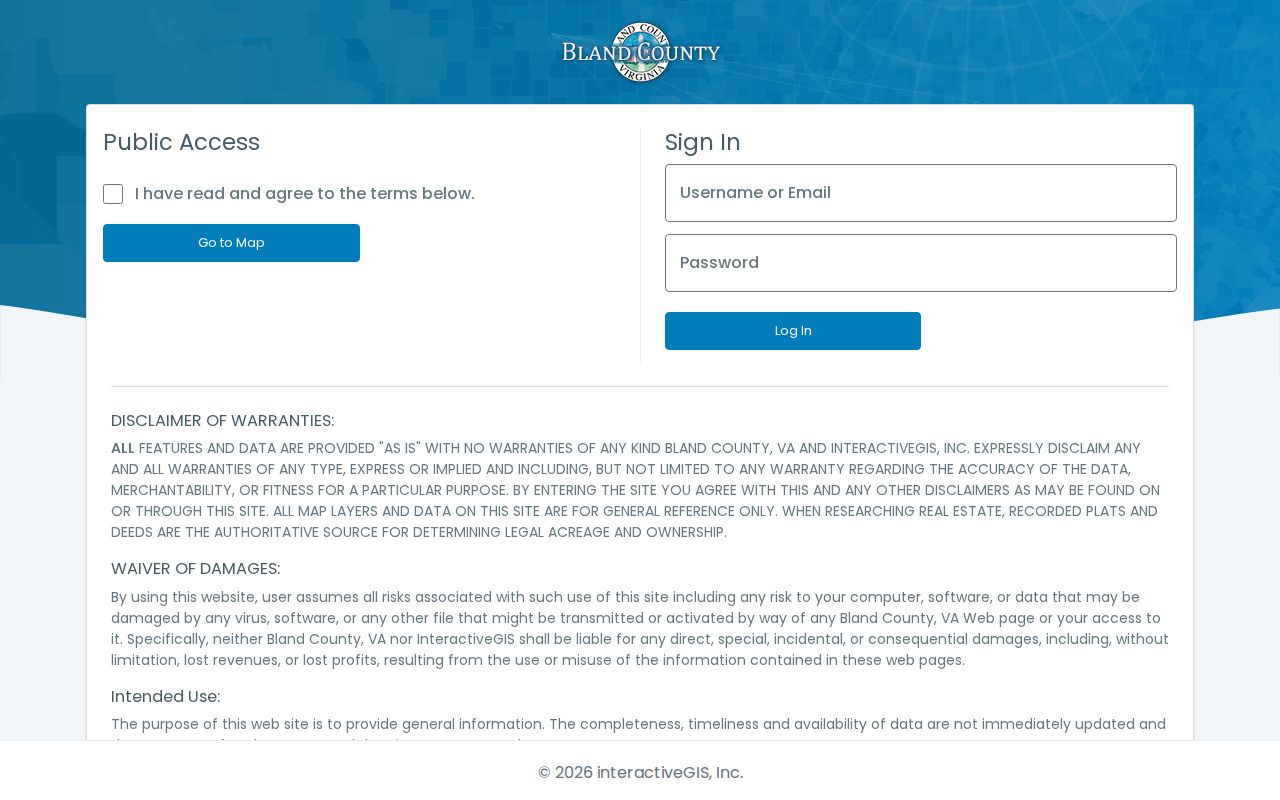
The agreement itself offers a sound habit. Save the parcel label as a search clue, then verify any line or acreage figure against the recorded source before you rely on it.
Communities in Bland County Records
The comprehensive plan names 24 communities in Bland County. These are Bland, Bastian, Ceres, Rocky Gap, Mechanicsburg, Hicksville, Hollybrook, Kimberling, Crandon, Effna, Grapefield, North Gap, South Gap, Clear Fork, Camp Laurel, Sharon Springs, Groseclose Store, Suiter, Carnot, Round Bottom, Point Pleasant, Pumpkin Center, Nobusiness, and Long Spur. These names are useful shorthand. They can turn an old description or a route address into a workable map search. But none of them is a separate town with its own assessor or deed office.
The distinction matters most with mailing labels. A letter may carry a community name while the land records stay put. Bland is the county seat. Yet it remains an unincorporated place. A mailing city never moves property records to a municipal clerk. The Circuit Court Clerk, Commissioner, Treasurer, and Building office serve all of Bland County. A road name may have changed. An old route address may no longer match. Widen the search. Owner name, acreage, adjoining owners, and deed description can all get you past a stale address.
Bland County's Deed Book Timeline
Bland County was formed in 1861 from parts of Wythe, Tazewell, and Giles Counties. Its own deed books start that same year. Anything earlier may sit in a parent county's records, so an older chain of title can cross a boundary. The Library of Virginia catalog traces the run: Deeds 1 covers 1861-1870, Books 2 through 7 reach 1901, a general grantor and grantee index runs through 1907, broader indexes extend to 1978, and continuation reels cover 1979-1980.
The catalog also lists Plat Book 1 for 1909-1976 and Surveyors' Book 1 for 1863-1926. Plats can explain a lot name or subdivision layout. A survey book may clarify an older metes-and-bounds description when the words alone fall short. The listing does not promise that every volume is digitized online, though. Where the SRA results stop, ask the Clerk about the original books and use the archival finding aid to request the correct reel.
The Library of Virginia's Bland finding aid lays out each land and court series by title and year.
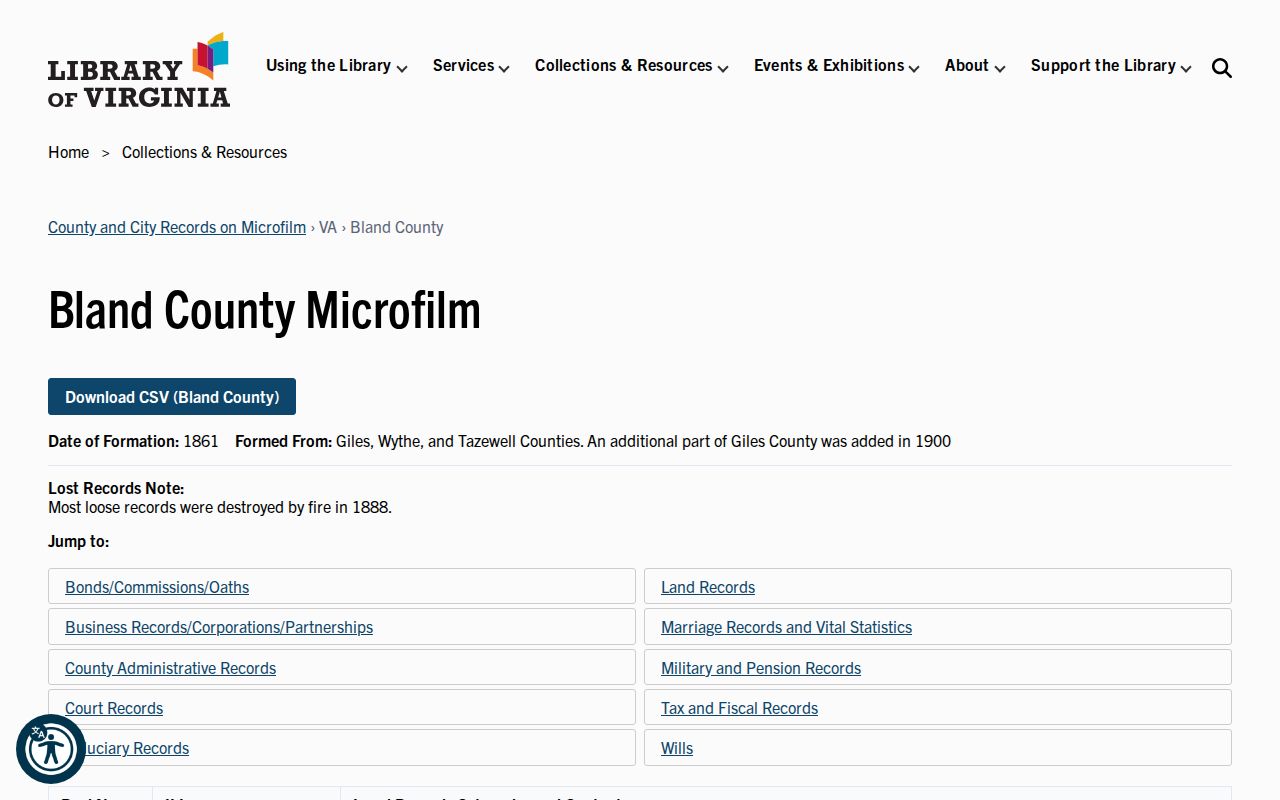
That reel list gives you a practical next step when a modern Bland County search turns up no earlier instrument. Write down the title and year span first. Then request the copy or archive lookup with those details in hand.
Bland County Reassessment Work
Bland County reassesses property on a cycle that takes 12 to 18 months. Every parcel gets a physical visit. Assessors study recent sales to set market-value rates for land, outbuildings, and structural features, and facts about quality and depreciation shape the final figure. The standard is fair market value under Virginia law. A tax assessment is not a sale offer. It is not a private appraisal either.
Site details can push value in either direction, since road access, views, waterfrontage, and flood zones all carry weight. A small tract can beat a large one per acre. The homesite may be valued apart from residual acreage. Barns, sheds, detached garages, incomplete structures, timber, and Christmas trees can each affect how the assessor reads the parcel. Acreage times price misses those differences.
Appeals go from the Commissioner to the Board of Equalization and then to the Bland County circuit court. Confirm the live filing deadline and required form with the Commissioner before acting.
Permit Records Across Bland County
Building, Planning and Zoning runs permits, zoning review, and inspections in Bland County. The application is detailed. It asks for project and owner details plus contractor information and comments. Flood-zone status, zoning district, and use come next. Conditional-use or permitted-by-right status, conservation-easement and VOF status, use group, and code date round out the form. Approvals from zoning, erosion-and-sediment control, and building officials are recorded, along with VDOT entrance-permit proof when it applies.
The office offers no address-keyed public permit search. Permits run on paper and PDF. Request a permit history by parcel or address. The printed charge fields show $0.16 per square foot or a flat fee, plus a 2% state surcharge. Verify the current amount with the office, since forms change.
Permit notes can add context about a proposed structure, access, flood status, or conservation review, but they do not establish deed ownership or surveyed boundaries. Pair the permit with the deed, plat, and assessment.
Estate Transfers in Bland County
Probate in Bland County runs through the Circuit Court Clerk. The Clerk serves as the county's probate clerk. Wills, estate qualifications, trustees, guardians, and fiduciary records can show why a parcel passed to heirs. They can also show a court-approved sale instead of an ordinary purchase deed. The county handles probate matters by appointment. Callers are asked to schedule at least 24 hours ahead.
Search the decedent's name and the fiduciary's name. Then watch for a recorded executor or administrator deed. Watch also for a distribution, an heir's conveyance, or an order tied to the land. A will by itself proves nothing about a later conveyance. The older county material is deep: fiduciary settlements from 1875-1970, appraisements from 1903-1969, fiduciary records from 1898-1910, and chancery and common-law order books. Those order books reach back to the 1860s.
Suppose the online index skips a transfer. An estate file or a chancery order may bridge that gap. Between the Clerk's records and the Library of Virginia reels, the county route and the archive route together cover this kind of work. Together they cover this kind of Bland County property records work.
Bland County FOIA Requests
Virginia's Freedom of Information Act lets anyone ask a custodian to inspect or copy an existing public record. A focused request works best. Name the parcel or address. Identify the record type and date range. State whether inspection, paper copies, or an electronic format is wanted. Requests can arrive in person, by mail, fax, email, phone, or another agreed method.
The Virginia FOIA Council sets the response clock. A public body must respond within five working days. The reply may deliver records, a denial, a clarification request, an estimate, or an explanation that more time is needed. Charges cover actual search, duplication, supplies, and lawful staff time. General overhead cannot be billed. The Public Records Act governs retention and preservation. It does not require web access or the creation of a new record.
Route requests to the right office. Ask the Bland County Commissioner for a land-book entry, the Circuit Clerk for an instrument or probate file, and the Treasurer for a tax ticket. One narrow request beats a vague county-wide search. Virginia FOIA guidance explains the request and response process, and Bland offices remain the custodians of their own records.
Protecting Bland County Property Records
Deed fraud worries plenty of owners. The Bland County Circuit Clerk posts a deed-fraud notice on its public page. That notice points owners to VADeed Alert, an email service that flags suspected fraudulent deeds, and it references Virginia's deed-fraud technical advisory effort. The Clerk's page lists no stand-alone signup address. Use the current official Clerk link rather than any third-party form.
An unexpected deed-copy mailer deserves caution. So does a caller posing as the sheriff. Check things through the Clerk's published phone number or a county domain. A tax ticket proves nothing about a payment link. Never send a Social Security number that way. For a suspicious instrument, contact the Circuit Clerk and ask how to check the land record.
Social Security numbers get protection too. The Bland Treasurer's tax-site notice explains that numbers used in official tax business stay confidential under Virginia Code sections 58.1-3 and 58.1-3017.
Openness has its limits. Virginia's Address Confidentiality Program gives eligible participants a substitute address, and identifying program records are exempt from FOIA.
Limits of Bland County Property Records
Bland County property records have limits. Each one shows what a particular office assessed, billed, mapped, filed, or decided. A land book can lag a recent transfer, since Virginia taxes property to the owner on January 1. Tax maps and GIS layers find tracts. They do not prove acreage, and a deed index can locate an instrument without showing its full image to every user. Check the source, date, and custodian.
Lawful use. Bland County records support property history, purchase diligence, assessment review, and civic research. A record search does not replace a title review or survey, and owner information must not be used to stalk, harass, threaten, or expose a protected address.